
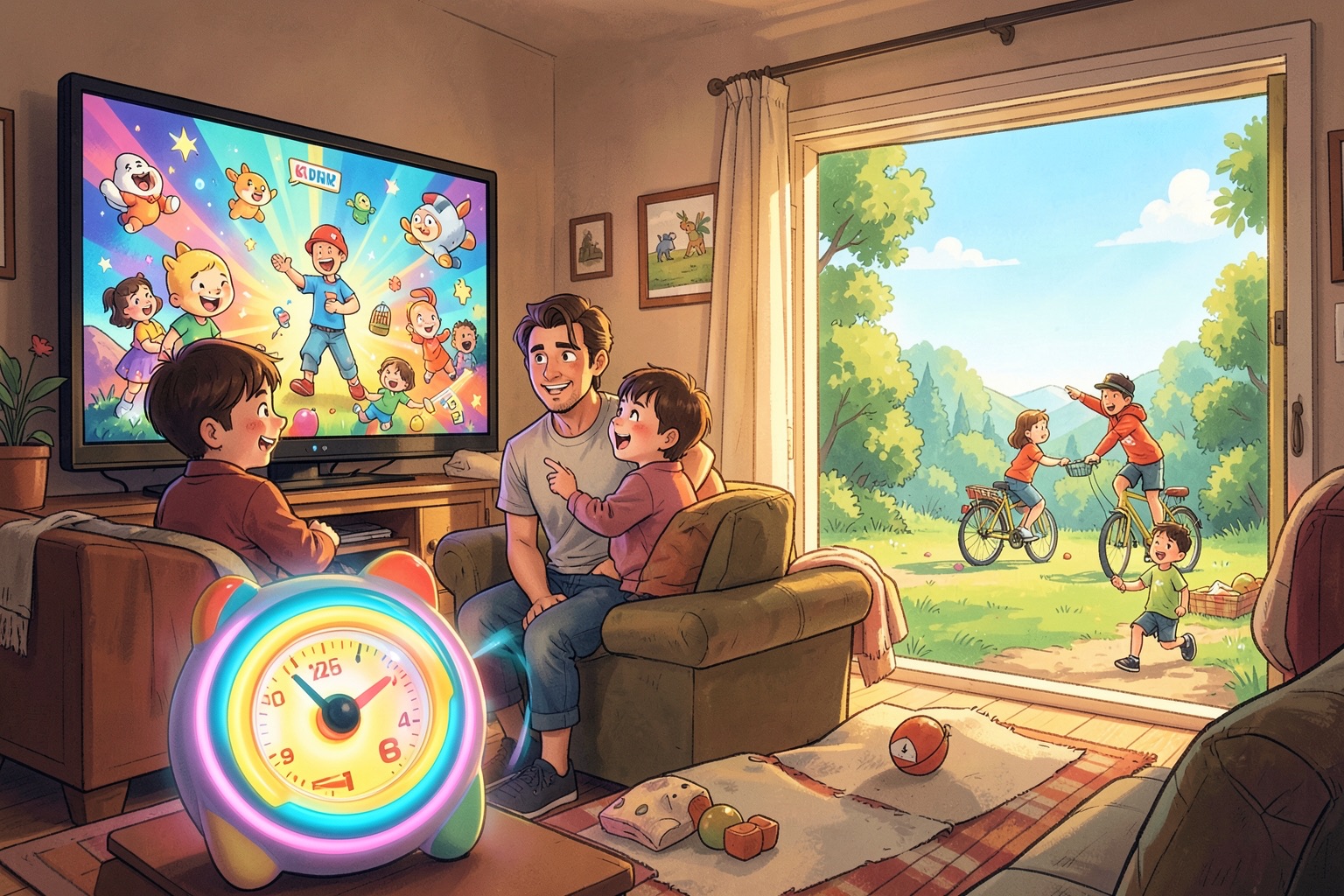
Parents have been fighting the same battle for years. You hand your child a screen to buy twenty minutes of quiet, then feel guilty about it afterward.
The guilt comes from a reasonable place. Most children’s programming treats kids like small couch potatoes. Sit still, watch the colorful shapes, and stay quiet.
But a different approach has been quietly gaining traction. Some shows are built around the idea that kids should move while they watch.
Danny Go! is one example. The show describes itself as a program designed to help children become confident in their limitless creativity [1]. Its YouTube channel features upbeat instructional dance songs that encourage children to move their bodies [2].
Which means the goal is not calm. The goal is controlled chaos.
Why Movement-Based Shows Work Differently
Traditional children’s television often operates on a sedation model. Slow pacing, soft voices, and gentle visuals keep kids still. There is a time and place for that, especially before naps.
Movement-based shows flip the script. They treat the screen as a starting point, not the whole experience. The child watches a few seconds, then stands up and starts mimicking what they see.
This shifts the cognitive load. Instead of passively absorbing information, kids practice motor skills, spatial awareness, and rhythm. They are interpreting instructions in real time and translating them into physical action.
That translation work is where the developmental value lives. Following a dance move requires listening, processing, and executing. It is a full-body comprehension exercise.
Danny Go! leans into this directly. Its content is described as high-energy silliness that encourages kids to get up and dance [1]. The YouTube channel frames its dance songs as a way for children to let out energy through movement [2].
In other words, the show is not trying to contain that energy. It is trying to channel it.
The Confidence Connection
The creativity and confidence angle is where this gets interesting. Danny Go! explicitly frames its mission as helping children become confident in their limitless creativity [1].
That is a bigger claim than teaching kids to wave their arms around. Confidence in creativity comes from repetition without judgment. When a child attempts a dance move and falls, nobody penalizes them. They get up and try again.
This mirrors how creative confidence develops in any domain. Writers write badly before they write well. Painters make messy canvases before they make good ones. Kids stumble through dance moves before they find their rhythm.
A show that normalizes this stumbling, that makes silliness the point, lowers the stakes of trying. The child does not need to get the move right. They just need to keep moving.
Here’s why that matters. Many children develop a fear of being wrong before they develop the skills to be right. Programs that celebrate effort over precision help delay that fear.
How To Use These Shows Without Surrendering Parenting
None of this means you should park your child in front of a screen and call it a gym class. The benefits of movement-based shows depend on how you use them.
The first principle is participation over observation. If your child watches someone dance and never stands up, the developmental benefit drops sharply. The screen is a prompt, not a babysitter.
The second principle is variety. A single show, no matter how good, becomes predictable over time. Predictability reduces engagement. Rotate between different movement-based programs to keep the experience fresh.
The third principle is joining in. When parents or siblings participate, the activity becomes social rather than solitary. Social movement builds different skills than solo movement.
Danny Go! is designed for this kind of shared experience. The show’s format invites children to come along for the ride [1], and its dance songs are built to be interactive rather than passive [2].
However, shared participation is not always realistic. Sometimes you need the show to do the work while you cook dinner. That is fine. The goal is consistency over perfection.
What Makes A Good Movement-Based Show
Not every program that claims to get kids moving actually does it well. Some are just regular shows with a token dance segment tacked on. Others are essentially exercise videos dressed up in cartoon clothing.
The best movement-based shows share a few characteristics. They give clear, simple instructions that a three-year-old can follow. They repeat movements enough times for kids to learn them. They build complexity gradually rather than overwhelming viewers.
They also leave room for interpretation. A good movement show does not demand exact replication. It demonstrates a pattern and invites the child to make it their own.
Danny Go! hits several of these marks. The show frames itself around high-energy silliness rather than rigid instruction [1]. Its YouTube content offers dance songs as a way to release energy, not as choreography to master [2].
Which means the bar is engagement, not perfection.
The Screen Time Conversation Adults Keep Getting Wrong
The debate around kids and screens has been stuck in binary mode for too long. One side treats all screen time as harmful. The other side treats all screen time as neutral.
Both positions ignore the content variable. Twenty minutes of a movement-based show that gets a child dancing is not the same as twenty minutes of autoplay video loops. The content shapes the effect.
Parents who feel guilty about screen time usually have a specific type of screen time in mind. The passive, glazed-over, completely still kind. That type deserves scrutiny.
Active screen time, where the child is responding physically to what they see, occupies a different category. It is closer to a guided activity than to passive consumption.
This does not make it automatically good. But it makes the blanket guilt less justified.
The question is not whether your child is looking at a screen. The question is what the screen is asking them to do while they look.
Practical Ways To Build Movement Into Viewing Time
If you want to make screen time more active, start with a few simple shifts.
First, clear the space. A child cannot dance safely in a room full of sharp coffee table corners. Move furniture or pick a spot with enough room to flail without injury.
Second, set the expectation before the show starts. Tell your child this is a dancing show, not a sitting show. Frame it as an activity, not as downtime.
Third, let them see you try. You do not need to be good at dancing. You need to be willing to look silly. That willingness teaches them that trying matters more than performing.
Fourth, keep sessions short. Ten to fifteen minutes of active movement is plenty for young children. Do not assume longer is better.
Fifth, follow their lead. If your child invents their own moves instead of copying the show, that is a feature, not a bug. Creative deviation is a sign of engagement.
Shows like Danny Go! support this approach because they are built around energy release and creative confidence rather than strict instruction [1][2]. The format gives kids permission to interpret.
When Passive Watching Still Has A Place
This is not an argument against ever sitting still. Children need rest. They need quiet moments. They need shows that slow them down before bed.
The point is balance. A media diet that includes movement-based shows alongside calmer content gives kids both outlets. They get to burn energy and wind down, depending on what they watch.
The mistake is defaulting to passive content every time. When the default is always sedation, kids lose the habit of responding physically to stimuli. They learn that screens mean stillness.
Movement-based shows break that association. They teach kids that a screen can be a starting point for action.
The Bottom Line For Parents
You will not eliminate screen time. Most parents have accepted that. The useful question is how to make the screen time that happens work in your child’s favor.
Movement-based programming is one tool for doing that. It turns a potentially passive experience into an active one. It gives kids permission to move, create, and be silly without judgment.
Danny Go! represents this approach well. The show is built to help children feel confident in their creativity [1] and offers dance content designed to help them release energy through movement [2].
No show replaces real-world play. Nothing on a screen substitutes for running outside, climbing things, and interacting with physical objects. But a well-designed show can bridge the gap between screen time and movement time.
If you are going to let your child watch something, consider letting it be something that asks them to stand up. The guilt may not disappear entirely, but the tradeoff becomes easier to justify.
Want to try it yourself? Pull up a dance episode, clear some floor space, and see who in your family actually has the moves.