
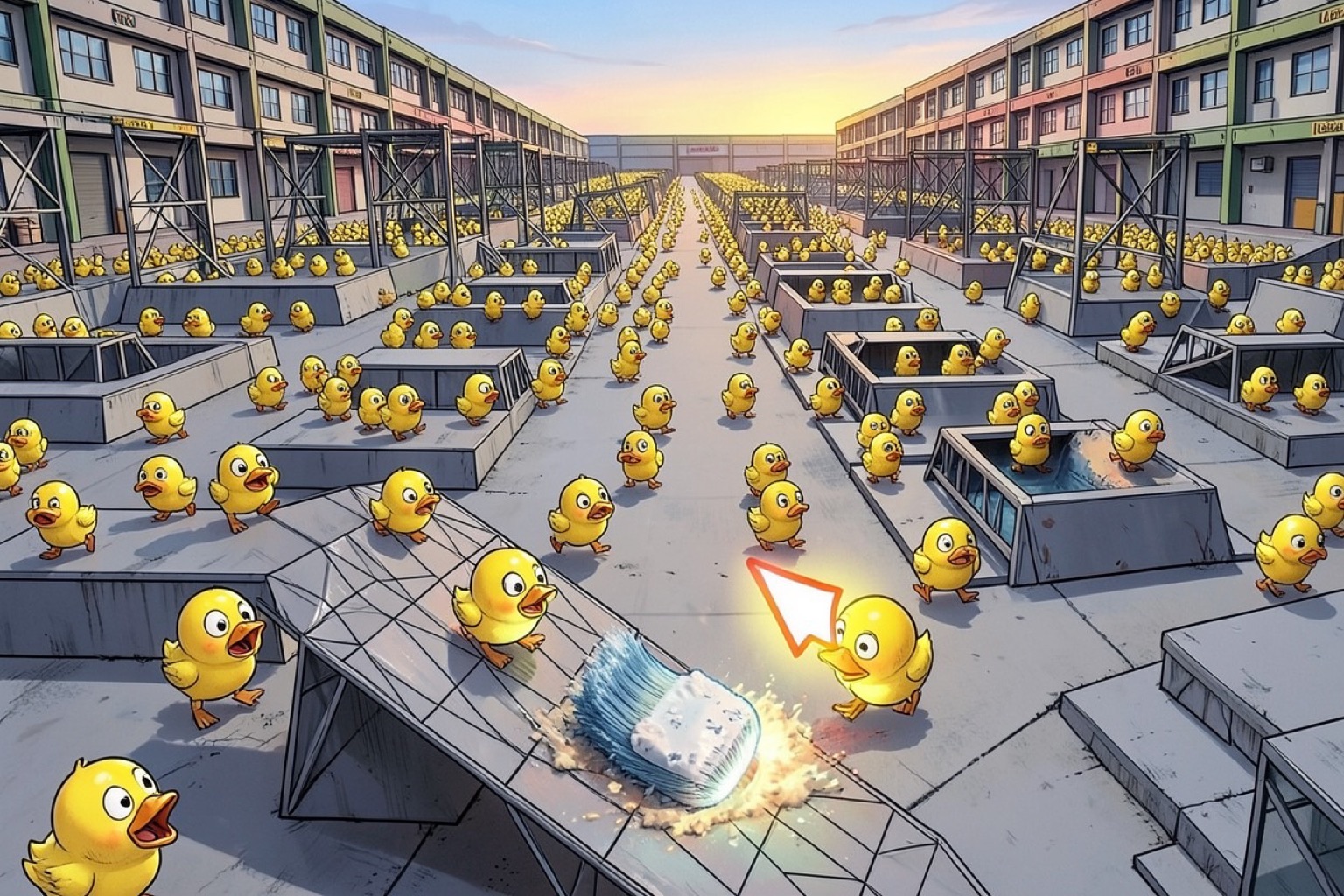
Building a robot’s training environment is often the most tedious part of the development cycle. Engineers must create 3D assets, design obstacle courses, and set up complex physics parameters.
New workflows are delegating this scaffolding to AI agents. This allows developers to move from a simple text prompt to a fully functional training environment with much less manual labor.
How do AI agents automate environment creation?
The process begins with a text prompt describing the desired task. Agents like Hermes and Nemotron 3.5 Bolt translate these prompts into detailed, step-by-step project plans [S1, S5]. These plans outline research, asset identification, and execution stages [1].
Once a plan is established, an agent named Astra handles the heavy lifting of asset creation [S1, S5]. Astra uses cloud image editing to refine visual references [S1, S5].
It then programmatically drives FreeCAD to build geometry and Blender to apply materials [S1, S5]. This allows for the creation of editable models and USD assets ready for simulation [1].
Why is physical accuracy necessary for navigation?
A robot must do more than just execute a walking policy. It needs to perceive its surroundings and maintain balance while navigating obstacles [1].
This requires a simulation that accurately models how a robot interacts with its world [1]. NVIDIA Isaac Sim provides the rendering and sensor simulation needed for this perception [1].
Meanwhile, the Newton physics engine models the robot’s movement and balance [S1, S5]. This setup allows the robot to learn how to adjust its actions when its path is blocked [1].
How is training scaled for complex tasks?
Training a robot to handle diverse terrain requires massive amounts of data. Isaac Lab provides the framework for reinforcement learning at scale [1].
This framework allows for the use of 4,096 parallel environments [S1, S3, S5]. Such large-scale training can run on high-performance hardware, such as an NVIDIA RTX PRO 6000 Blackwell Workstation Edition GPU [S1, S3].
The robot uses specific inputs, such as head-camera depth and its own state observations, to learn locomotion policies [S1, S3]. This scale helps the robot master movement through constrained spaces and over uneven surfaces [S1, S3].
How do developers prepare for real-world deployment?
Moving a policy from simulation to a physical robot is difficult because of the gap between simulated and real-world behavior [3]. Differences in physics and sensor noise can cause failures during deployment [3].
To address this, developers use domain randomization of physical parameters [3]. They also utilize Better Actuator Models (BAM) to simulate real-world mechanical behaviors [3].
BAM models account for command delays, mechanical backlash, and voltage drops as motors draw power [3]. Matching these simulated settings to real robot measurements helps ensure the robot performs reliably once it leaves the simulator [3].
If you are looking to accelerate your own robotics pipeline, you can explore the SimReady Central Library, which offers more than 2,000 simulation-ready OpenUSD assets [3].
Sources
- Using AI Agents to Teach Robots Like Microduck to Walk in Simulation
- NVIDIA Shows AI Agents Building a Simulation to Train the Microduck Robot
- Using AI Agents to Teach Robots Like Microduck to Walk…
- Using AI Agents to Teach Robots Like Microduck to Walk in Simulation
- From Simulation to Production: How to Build Robots With AI - NVIDIA Blog
- From Prompt to Walking Robot With NVIDIA RTX Spark
- AI Robotics Platform, Tools & Simulation | NVIDIA
- Using AI Agents to Teach Robots Like Microduck to Walk in Simulation