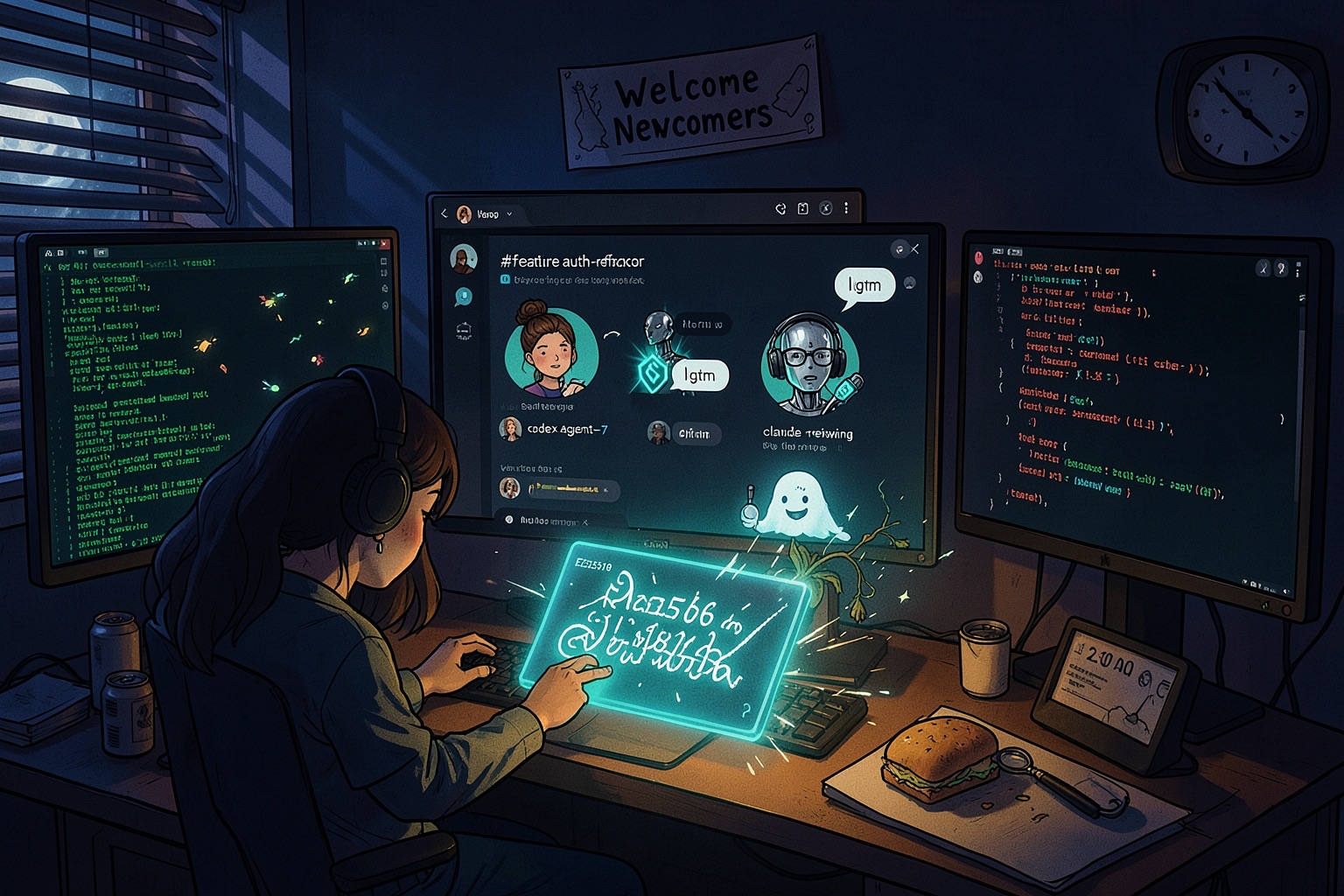
Slack has been the default place to put team conversation for more than a decade. It was built for a clear bottleneck of its era, letting humans talk to each other across silos. On July 21, 2026, Jack Dorsey’s Block released a product that argues the bottleneck has moved from intelligence to coordination, and that the old chat model is no longer the right shape. The product is called Buzz, it is open source under the Apache 2.0 license, and it was built so that humans and AI agents can work in the same channels as peers rather than as bots lurking behind a slash command.
That framing matters. The Buzz versus Slack question is not really “which chat app is nicer.” It is a choice between a mature, polished, vendor-owned platform built for the last bottleneck and a pre-1.0 open source project betting that the next wave of work is human plus agent coordination. Both can be the right answer depending on what your team actually does.
Here is a grounded comparison so you can decide which one fits your workflow in 2026.
What Buzz actually is
Buzz is a free, open source group chat platform from Block, the company Jack Dorsey co-founded. It launched on July 21, 2026, and Dorsey described it on X as model agnostic, decentralized, self sovereign, and open source. In plain terms that means it is not locked to one AI model vendor, runs on servers you control rather than a vendor’s cloud, and lets your team own its own identity and data.
The technical foundation is unusual for a chat app. Buzz is a Nostr relay with a chat client attached. Nostr is a simple open protocol where every message is a cryptographically signed event relayed through any compatible server, so nothing a person or agent writes can be silently altered after the fact. Identity is a cryptographic keypair you hold rather than an account a vendor provisions for you. The stack is written in Rust on top of Axum, Postgres, Redis, and S3 or MinIO, and a Docker Compose bundle in deploy/compose/ lets you run the whole thing on your own hardware.
The single most distinctive idea is how agents fit in. In Buzz, an AI agent is a full member of the workspace, not a bot. The key shift is that an agent does not act through a platform-issued bot token. It gets its own signing key and a narrow permission scope, and every message it writes is cryptographically attributed to that key, so authorship cannot be quietly faked or erased. That matters once an agent is opening pull requests or writing code, where you want to know who or what actually produced a change.
The code review angle is the other half of the pitch. Buzz folds git primitives directly into chat with commands like buzz repos, buzz patches, buzz pr, and buzz issues. The design idea, as Block puts it, is that a feature branch is a channel, which folds chat, pull requests, reviews, and issue tracking into one signed event log. That is why Buzz gets called a challenger to both Slack and GitHub, not just Slack.
It is early. The desktop app sat at v0.4.22 around launch, and the repo had roughly 1,800 commits and 3,600 stars in its first days. As of early August 2026 the public repo at github.com/block/buzz had grown past 19,000 stars and 2,000 forks — numbers that will keep moving as the project matures.
What Slack actually is
Slack launched publicly in August 2013, founded by Stewart Butterfield and the team that originally built a failed game called Tiny Speck, and the codename Slack stood for Searchable Log of All Conversation and Knowledge. Salesforce acquired it in July 2021 at a peak valuation near $27.7 billion, and it has become the default workplace chat for a large share of knowledge work companies.
Where Buzz is protocols and keys, Slack is enterprise software. Its feature set is deep and proven. Slack AI summarizes channels and threads so people can catch up on missed conversation. Salesforce’s Agentforce lets teams deploy AI agents that act on customer and CRM data sitting in Salesforce. Slackbot works as a personal assistant that can route other agents and tools into a conversation. Beyond that there is Workflow Builder for no-code automation, Canvas for shared persistent notes pinned to a channel, Lists for lightweight task tracking, Slack Connect for shared channels with outside partners, and Slack Atlas for org charts and people profiles.
On the governance side Slack offers Enterprise Key Management so admins can monitor and revoke access, plus an audit and compliance posture built for regulated industries. This is the layer most open source projects simply do not have, and it is a large part of why large companies pay for Slack rather than running something themselves.
Pricing is the practical question most teams ask first. Slack’s paid tiers as listed on its US pricing page are Pro at $6.75 per user per month billed annually and Business+ at $15 per user per month billed annually, with Enterprise Grid handled as a contact sales quote. A 200-person team on Pro is on the order of $16,000 a year, and a 2,000-person company on Business+ is approaching $360,000 a year. Those figures change, so confirm the current tiers on Slack’s site before budgeting.
Where they genuinely differ
How agents live in the workspace
This is the line that separates the two products most cleanly. In Slack, an agent is an integration. You install an app, you hand it a bot token the platform issued, and it posts on a webhook or responds to a slash command. The agent can do useful things, but it is a tenant in Slack’s house, acting through permissions Slack grants and revokes.
In Buzz, the agent is the signed author described in the section above, not a token holder. Block’s argument is that the platform-issued token model is the wrong abstraction for a world where an agent might write code, open a pull request, and ask a human to review it in the same channel. Whether you buy that abstraction probably determines whether you find Buzz interesting or over-engineered.
The model agnostic design matters here too. Buzz works with harnesses like Claude Code, OpenAI Codex, and Goose through a protocol layer called buzz-acp, so a team is not locked to one model vendor. Slack agents can also call any model, but through whichever integration you wire up rather than as a native protocol assumption.
Self-hosting and data residency
Slack is a managed service. Your messages live on Salesforce infrastructure, you trust their compliance program, and you pay per seat. Buzz is self-hostable from a Compose bundle, which means a team that needs strict control over where data sits can run it on its own cloud or on prem. That is a real advantage for regulated workloads, but it is also work you now own. There is no vendor to page at 3am when Nostr relays fail.
Cost
Buzz’s desktop app is free, and self-hosting costs whatever your infrastructure bill is. Slack’s per-seat model scales linearly with headcount, which adds up fast at hundreds or thousands of seats. For a small engineering team that wants agent-rich chat, Buzz is materially cheaper. For a 5,000-person enterprise that needs SSO, audit logs, data retention controls, and a support contract, the per-seat cost is the price of not running a chat platform as a side project.
Maturity and ecosystem
This is where Slack wins without contest. It has a decade of integrations, a documented admin experience, enterprise certifications, and the kind of polish that only comes from being the default. Buzz is a pre-1.0 project that shipped weeks ago. Its integration surface is the Nostr protocol and the agent harnesses it speaks to, not a marketplace of thousands. If your team needs stability and breadth today, Buzz is not the safer choice, and pretending otherwise would be dishonest.
Philosophy over features
The interesting disagreement is not really about features. Slack assumes the future of work is humans in chat with ever smarter assistants plugged in, owned by the platform vendor. Buzz assumes the future is a mix of human and agent authors operating on shared signed state, owned by whoever runs the relay. Block’s stated thesis is that the bottleneck moved from intelligence to coordination, and Buzz is built for that coordination problem. Slack is built for the previous bottleneck, which was letting humans talk to each other across silos.
When each is the right pick
In short, Buzz is for a small, technical, agent-heavy team that can run its own infrastructure and would rather own a workspace than rent one. Slack is for everyone else, especially larger organizations that need governance, integrations, and a support contract they can call.
Buzz is worth a serious look if your team is agent-heavy, technically capable, comfortable running infrastructure, and either priced out of Slack at scale or constrained enough on data residency that self-hosting is non-negotiable. It is especially appealing for small engineering teams already living in git who would rather have one workspace for chat, patches, and reviews than three tabs.
Slack remains the right default if your organization needs enterprise governance, a deep integration catalog, mature admin tooling, and a vendor support contract, or if most of your users are not developers and should not be expected to reason about keypairs and Nostr relays. The cost is real, but so is the cost of running a pre-1.0 chat platform for a non-technical company.
For a lot of teams in the middle, the honest answer in August 2026 is to keep Slack and watch Buzz. Buzz is unusually thoughtful for something this young, and the agent-as-signed-author idea may well age better than the bot token model. What it has not yet proven is whether the open source Nostr approach can hold up under the weight Slack carries every day, and that proof takes time, not a launch week.
Buzz vs Slack FAQ
Is Buzz free?
Yes. The desktop app is free, and the whole project is open source under the Apache 2.0 license at github.com/block/buzz. If you self-host, your only cost is the infrastructure you run it on. Slack’s paid tiers start at roughly $6.75 per user per month on Pro and around $15 per user per month on Business+, and Enterprise Grid is a sales quote.
Can Buzz replace Slack today?
Only for a narrow kind of team. If you are a small engineering group that lives in git, works heavily with AI agents, and is comfortable running Rust services on your own infrastructure, Buzz can replace Slack. For a large company that needs SSO, audit logs, data retention controls, a deep integration catalog, and a support contract, Slack is still the practical default. Buzz is pre-1.0 and shipped in July 2026.
At what scale do Buzz’s savings outweigh the burden of running it?
There is no clean break-even point because the burden is mostly fixed and the Slack bill is mostly per seat. The infrastructure to run a small self-hosted Buzz instance costs roughly the same whether the team is 5 people or 50, while Slack’s per-seat spend climbs linearly. That means a handful of engineers paying a tiny infra bill can already beat Slack’s per-seat cost, but a 500-person company only wins on price if it can also absorb the staffing cost of owning uptime, security, upgrades, and support for a pre-1.0 platform. Below a technical team of roughly a few dozen, the savings tend to justify the burden. Above that, the operational risk usually eats the savings.
Is Buzz safe for a production team right now?
It is safer to call it experimental than production ready. The desktop app was at v0.4.22 around launch, the project is weeks old, and there is no established enterprise support or compliance program. Self-hosting means you own the security and uptime burden. For regulated or non-technical organizations, that risk is not worth the cost savings yet.
Does Buzz replace GitHub too?
That is part of the ambition. Buzz folds git primitives into chat with commands like buzz repos, buzz patches, buzz pr, and buzz issues, treating a feature branch as a channel. For a small team it can consolidate chat, pull requests, and issue tracking into one workspace. For a large codebase that depends on CI dashboards, marketplace apps, and mature code review tooling, GitHub still has a much larger surface.
Sources
- block/buzz - GitHub
- Jack Dorsey is taking on Slack with Buzz, a group chat platform for teams and their AI agents - TechCrunch
- Buzz: Block’s agent-native messaging on Nostr - Developer’s Digest
- Buzz: Block’s Slack and GitHub challenger for AI teams - Eesel
- Slack (software) - Wikipedia
- Slack AI - Slack
- Slack pricing (US) - Slack
- Slack pricing (UK) - Slack