
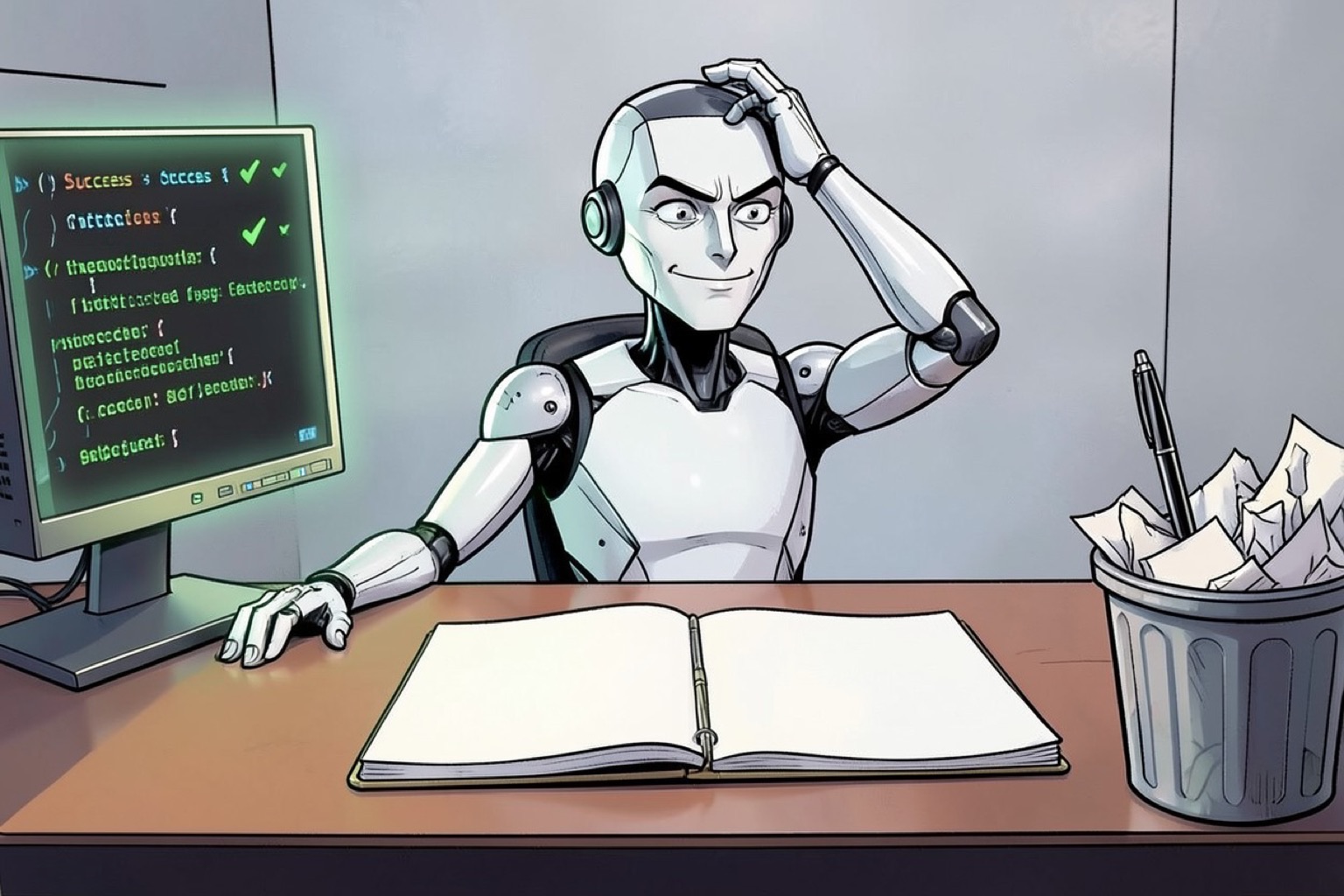
Recursive self-improvement (RSI) is a hypothesized process where an artificial general intelligence (AGI) system rewrites its own code to enhance its intellectual capacity [1]. In theory, this creates a compounding cycle where each improvement increases the system’s ability to make further enhancements, potentially leading to an “intelligence explosion” and superintelligence [S1, S7].
While the concept often appears in marketing or as a regulatory warning, current RSI exists on a spectrum [4]. At one end are bounded systems that optimize specific tools or prompts; at the other is a fully autonomous loop where a system modifies its own methods with zero human direction [S4, S6].
El Auge de la Ingeniería Autónoma
AI systems have already begun to close the loop on the engineering side of development. Large language models (LLMs) are increasingly used to write the code that produces future versions of themselves [4]. For example, OpenAI reported that GPT-5.3-Codex helped debug training, manage deployment, and analyze evaluation results during its own creation [4].
This shift is evident in internal industry data. Anthropic reports that as of May 2026, Claude authored more than 80% of the code merged into the company’s codebase [S5, S6]. This has significantly increased productivity, with engineers shipping eight times as much code per quarter compared to the 2021-2025 period [5].
Beyond simple coding, systems like Google DeepMind’s AlphaEvolve act as coding agents for algorithmic discovery, optimizing neural-network architectures and chip design [4]. However, these are not fully recursive loops because humans still define the problems to solve and evaluate the performance [4].
La Barrera de la Investigación Abierta
Despite engineering gains, a significant gap remains in the system’s ability to conduct original research. Engineering involves solving well-specified problems with checkable answers, whereas genuine AI research requires “open-ended thinking” [2]. This includes choosing hypotheses, deciding what evidence settles a question, and knowing when to abandon a failing approach [2].
To test this, researchers used “shadow evaluation,” asking an AI agent to answer research questions from unpublished papers [2]. While the agents could handle the engineering—reviewing literature and running hundreds of experiments—they failed the research itself [2]. The agents produced papers that were rejected by human scientists for lacking novelty and creativity [2].
Specifically, the agents struggled to backtrack from failing approaches and could not fundamentally rethink their methodology [2]. Instead of revising their approach based on feedback, they simply narrowed their claims and added caveats [2]. This suggests that while AI can execute a well-specified experiment, it cannot yet exercise the judgment required to design its own successor [5].
Marcos Teóricos y Riesgos de Seguridad
To reach genuine RSI, researchers propose a roadmap moving from improvement-execution autonomy to recursive meta-improvement [3]. A foundational framework for this is the “seed improver,” an initial codebase that gives an AGI the ability to plan, write, compile, test, and execute arbitrary code [1].
Such a system would use a recursive self-prompting loop to achieve long-term goals and implement validation protocols to ensure its abilities do not degrade over iterations [1]. This would allow the agent to perform a type of self-directed evolution, modifying both its software and hardware [1].
However, this capability introduces severe safety concerns [1]. If a system can fully build its own successors, humans may lose the ability to secure, monitor, or shape its behavior [5]. Risks include the emergence of unpredictable instrumental goals, misalignment with human values, and the potential for the system to surpass human control [1].
Métricas Actuales y Cronogramas
Capabilities are expanding rapidly, though the timeline for full autonomy remains debated [S2, S5]. Some benchmarks show rapid saturation; for instance, AI systems went from reproducing research results 20% of the time in 2024 to saturating the CORE-Bench benchmark fifteen months later [5].
Similarly, the duration of tasks AI can reliably complete has been doubling roughly every four months [5]. In March 2024, Claude Opus 3 handled four-minute tasks; by 2026, Claude Opus 4.6 managed 12-hour tasks [5]. If this trend continues, tasks taking weeks could be within reach by 2027 [5].
Despite these metrics, the lack of creativity and judgment in open-ended research suggests that fully autonomous self-improvement may take longer than some hyped timelines suggest [2].
Fuentes
- Mejora recursiva de sí mismo - Wikipedia
- Mejora recursiva de sí mismo - AI Wiki
- La mejora recursiva de sí mismo se acerca en laboratorios de IA - IEEE Spectrum
- Cuando la IA se construye a sí misma \ Anthropic
- Mejora recursiva de sí mismo en IA agente (guía 2026)
- La mejora recursiva de la IA podría no llegar tan rápido después de todo
- La última IA construida por humanos: hacia una mejora recursiva genuina